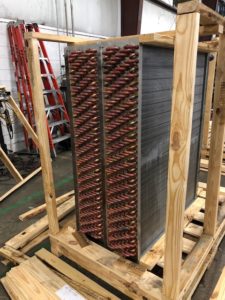
Every Chilled Water Coil selection is about balance. Your coil selection balances the rows/fins versus the cost of the coil pressure drops/performance. Trying to cut corners on your initial selection may save you money upfront, but you will inevitably pay it back down the line through added energy costs. This is a truism for every manufactured coil.
- Fins cost less money than rows/tubes. A good cost-cutting tool when selecting a coil is to choose 14 fins/inch. This will turn your (8) row coil into a (6) row coil, which will dramatically lower your costs. If you choose to go this route, one thing to keep in mind is that 14 fins/inch will be semi-inconvenient to any maintenance crew tasked with cleaning the coil. Don’t expect a Christmas card from them that year.
- That raises the question of whether or not you can even clean a deep (6) or (8) row coil? In short, you can, but it is not easy. Chilled water coils are especially difficult to clean because they are almost always wet. Due to this fact, they typically attract dirt and additional particles that other coils do not. Generally, when cleaning a coil, most of the dirt get pushed to the middle, and for that reason, 14 fins/inch may not be the best idea after all.
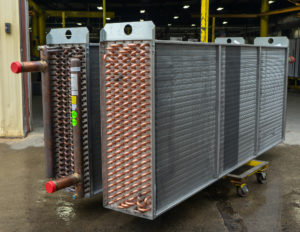
- Did you know that fins do approximately 70% of the heat transfer in a chilled water coil, while the tubes are only responsible for the remaining 30%? This is precisely why the fin/tube bond is so important. Without a perfectly crafted fin/tube bond, coils become inefficient very quickly. You pay for that inefficiency through increased energy costs.
- How long does a coil last? At what age can I expect my coil to fail? Unfortunately, there is no single answer to either question. Everything is dependent on a combination of maintenance, duty, and numerous other factors. If your initial selection was correctly chosen, and proper maintenance was kept, 15-20 years is a good timeframe.
- You may have a situation where your coil is 20 years old, and everything appears to be operating in good condition. There are no leaks and all looks ok. However, over that length of time, what you don’t see is that the fins have thinned and are no longer bonded to the tubes, and the coil is dirty in places that you cannot see. Again, while the coil may look to be running in top form, it’s probably only running at 60% capacity. Most likely, the tubes have also thinned over time, so when the next deep freeze occurs, you can guess the likely outcome.
- You really need to replace the coil, but have been told to make do with the current coil? To make up for the lack of efficiency, you might try to “jury-rig” your system. One method is to change the drive on the fans to deliver more CFM. This increases the air pressure drop, which in turn increases motor brake horsepower. Another option to help increase the coil’s efficiency is to lower the temperature of the chilled water from the chiller. We tend to mess with the system and apply temporary Band-Aids, when replacing the coil is the only guaranteed long-term solution.
- If you want to spend money wisely on a chilled water coil, simply make the tubes thicker. The tube thickness for a 5/8” tube coil is .020” thick, so increase the tube thickness to .025”. The same applies for a ½” tube coil, with a tube thickness of .016”. Increase it to .020”. By doing this, you get the added bonus of making your return bends thicker, which also helps to extend the life of the coil.
- Not quite sure about circuiting on a chilled water coil? You are going to have a hard time making an accurate selection unless you understand how to circuit a coil. Circuiting is really nothing more than selecting the number of tubes that you want to feed, and how many passes the water makes through the coil – depending on your GPM. Circuiting is one of the most important factors in ensuring that your coil is running at peak-performance.
- Curious about the balance between cost, size, materials, and maintenance? Every chilled water coil needs to be maintained for its entire life-span. If you’ve made your selection, and something seems off about the coils, chances are mistakes were made during the selection process. Some indicators include the coil being too big for the space allowed, or incurring out of control energy costs. What is the point of saving $500 on a chilled water coil if you have to spend $5,000 in maintenance over its life-span?
As coil replacement experts, we run into this issue every day. Our goal is to work with you to ensure your selections are correct the first time. The person in charge of budgets will be grateful to you over time. Capital Coil & Air welcomes the opportunity to work with you on your next coil project! We want to be your coil replacement specialists.
RELATED POSTS
Chilled Water Coil Circuiting Made Easy